Video marketing is no longer something only large brands can afford. For Rio Grande Valley businesses, it has become one of the most practical ways to build trust before a customer ever calls, visits, schedules, or submits a lead form. A short video can show the people behind the business, explain a service more clearly than a paragraph, answer common customer questions, and make a local brand feel more familiar in a crowded digital market.
That matters in the Valley because buying decisions are still deeply tied to trust. Customers want to know who they are dealing with. They want to see the location, hear the explanation, understand the process, and feel confident that the business can help them. A polished website and active social media presence are important, but video can make the brand feel real in a way static content often cannot.
The opportunity is not simply to post more Reels, TikToks, or YouTube Shorts. The opportunity is to tell better local stories. For RGV businesses in McAllen, Edinburg, Mission, Pharr, Weslaco, Harlingen, Brownsville, and nearby communities, the strongest video strategy connects the business to real customer questions, local context, service expertise, and a clear next step.
The goal is not to chase viral attention. The goal is to turn useful attention into stronger recognition, better leads, and more confident customers.
Why Video Matters for RGV Businesses Right Now
The Rio Grande Valley is a large, growing regional market. Recent reporting based on U.S. Census estimates places the four-county RGV region of Hidalgo, Cameron, Starr, and Willacy at roughly 1.4 million residents. That means local businesses are competing for attention across a serious population base, not a small town audience.
At the same time, customer attention is fragmented. People compare businesses on Google, Facebook, Instagram, TikTok, YouTube, review sites, and sometimes through direct recommendations in group chats or community pages. Pew Research Center data from 2025 shows that YouTube and Facebook remain the most widely used social platforms among U.S. adults, while Instagram and TikTok continue to play major roles for younger and more visually oriented audiences.
For local brands, this means video has to do more than look nice. It has to help the customer understand something quickly. It should answer questions, reduce doubt, show proof, and make the business easier to remember when the customer is ready to act.
In practical terms, video can help an RGV business:
- Build familiarity by showing real people, real locations, and real work.
- Explain services that are hard to understand from text alone.
- Support local SEO when videos are added to useful website pages and optimized properly.
- Improve social media trust by giving followers a reason to pay attention beyond promotions.
- Strengthen lead quality by educating prospects before they contact the business.
The Best Local Videos Start With the Customer, Not the Camera
Many businesses delay video marketing because they think they need a full production crew, perfect lighting, expensive equipment, or a complicated content calendar. Those things can help, but they are not the starting point. The starting point is the customer question.
A strong video begins with something your audience already cares about: what does this service cost? How long does it take? What should I expect? Is this business trustworthy? Do they serve my area? Do they speak my language?
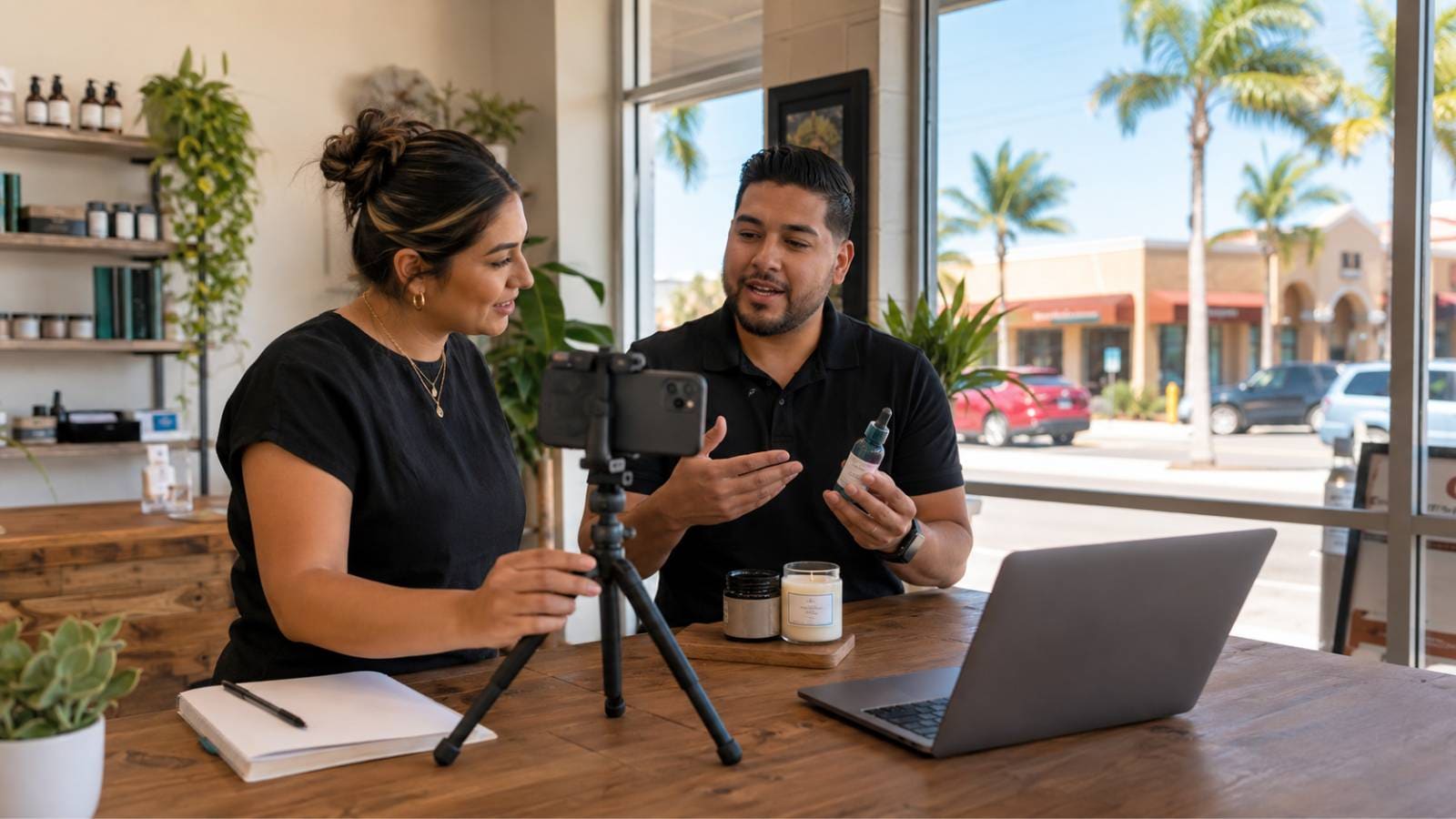
When the video answers a real question, production quality becomes the supporting element instead of the whole strategy. A clean, steady, well-lit smartphone video with a useful answer can outperform an expensive but generic brand video that says very little.
For RGV businesses, practical customer-driven video topics might include:
- A contractor explaining what homeowners should check before hurricane season.
- A clinic explaining what new patients should bring to their first appointment.
- A dealership showing how a trade-in appraisal works.
- A restaurant introducing a popular lunch special and the story behind it.
- A law office explaining a common local service question in plain English.
These are not vanity videos. They are trust-building assets.
What Makes Video Storytelling Feel Local?
Local storytelling does not mean forcing city names into every sentence. It means making the content feel connected to the real customer experience in the Rio Grande Valley.
For an RGV business, local nuance can show up in the setting, the language, the examples, the people, the seasonality, and the problem being solved. A video about preparing an AC unit for South Texas heat is more locally meaningful than a generic "summer maintenance tips" video. A bilingual office walkthrough may be more useful than a generic brand montage. A behind-the-scenes clip from a McAllen storefront or Brownsville service route can feel more trustworthy than a stock-looking studio shoot.
The best local videos usually include at least one of these trust signals: a real person from the business, a real environment, a real customer question answered without jargon, a real local reference, and a real next step.
Short-Form Video Is Useful, But It Should Not Be Random
Short-form video is important because it fits how people consume content on mobile devices. Reels, TikToks, YouTube Shorts, and Facebook videos can all help local businesses reach people who may not be actively searching yet. But the format does not replace strategy.
A 20-second video still needs a point. Strong short-form videos usually follow a simple structure:
- Hook: Name the question, mistake, benefit, or local situation quickly.
- Value: Give one clear answer, tip, example, or explanation.
- Proof: Show the team, process, customer result, location, or product.
- Next step: Tell the viewer what to do next without sounding desperate.
For example: "If you run a service business in McAllen, do not send Google Ads traffic to your homepage. Send people to a page that matches the service they searched for. Want us to review yours? Book a quick audit." That kind of video is short, practical, and tied to a business outcome.
Longer Videos Still Have a Place
For more considered purchases, remodeling, healthcare, legal, financial, education, B2B, longer videos give buyers room to evaluate expertise. These can live on YouTube, on service pages, on landing pages, in email follow-up, or in sales enablement materials.
Where to Embed Video on Your Website
RGV businesses should consider adding video to:
- Service pages where prospects need to understand the offer.
- Location pages where the business wants to build local familiarity.
- FAQ pages where short answers can be made more human.
- Blog posts where a visual explanation strengthens the article.
- Landing pages where a trust-building video can support paid ad traffic.
A video should not be embedded just to decorate a page. It should help the visitor make a better decision.
Production Quality Should Match the Moment
Not every video needs the same level of production. Some videos should be simple, fast, and authentic. Others should be more polished because they represent the brand on a homepage, paid campaign, recruiting page, or major service page.
Bilingual Content and Accessibility
Not every RGV business needs every video in English and Spanish. But businesses serving bilingual customers should think carefully about language, captions, and tone. A Spanish version, bilingual caption, or separate short clip can sometimes make the content feel more useful and welcoming.
Accessibility also matters. Videos should avoid relying only on tiny on-screen text, fast cuts, or unclear audio. Clear captions, readable text, good lighting, and simple explanations make content more usable for more people.
How Video Turns Into Leads
A video strategy should connect to a conversion path. If a business posts videos but never gives people a clear next step, the content may build awareness without producing measurable opportunities.
Useful metrics include video completion rate or average watch time, clicks to the website from social video posts, calls, forms, and bookings from video-supported landing pages, and engagement quality (saves, shares, comments, DMs).
Common Mistakes to Avoid
- Making every video a sales pitch.
- Copying national trends without local relevance.
- Ignoring sound and lighting.
- Posting without captions.
- Creating videos with no CTA.
- Measuring only views.
The businesses that win with video are not always the ones with the biggest budgets. They are often the ones that communicate clearly, show up consistently, and understand what their customers need to see before they feel comfortable acting.
Final Takeaway: Better Stories Create Better Trust
For Rio Grande Valley businesses, video marketing is not about chasing trends. It is about telling better local stories that help real customers understand who you are, what you do, and why you can help.
Want a video strategy that actually drives leads for your RGV business? BRT Digital can review your existing content, social presence, website, and paid media setup and recommend where better creative would move the needle fastest. Request a video and content strategy audit or book a strategy call.