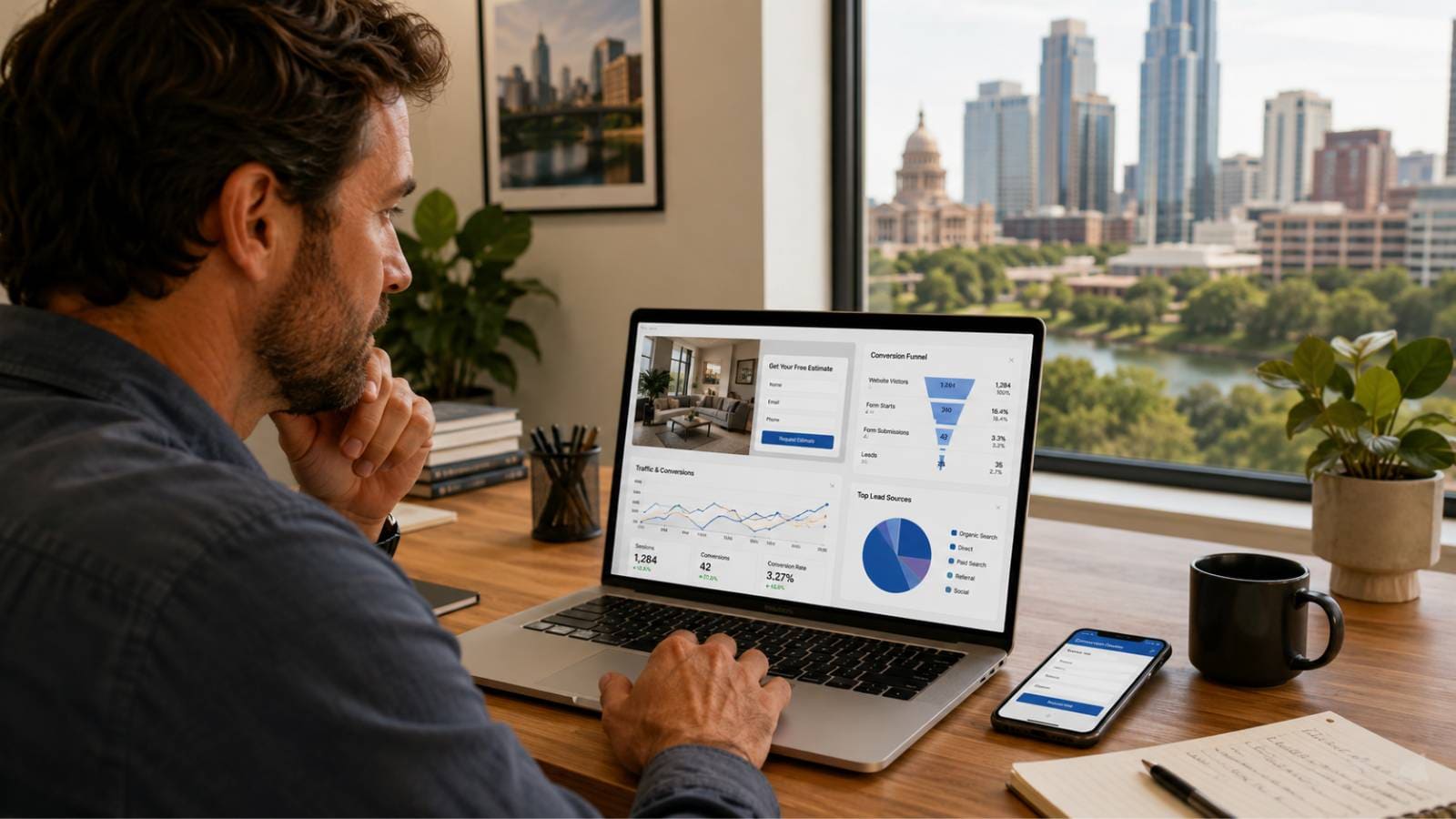
A good-looking Austin website can still lose most of its visitors before they ever call. The city passed an estimated one million residents in 2025 (Census QuickFacts), and buyers here are used to polished sites from tech companies and startups. They decide fast, compare several providers at once, and leave when the next step is unclear. That is why conversion work often pays off faster than buying more traffic.
That creates opportunity, but it also creates pressure. Search clicks are competitive. Paid media is more expensive than many business owners expect. Social attention is fragmented. Referral traffic is valuable but inconsistent. In a market like Austin, getting more website traffic is only part of the job. The bigger question is whether that traffic is turning into useful business outcomes.
Conversion rate optimization, often called CRO, is the discipline of improving a website so more visitors take the next meaningful step. For a Travis County business, that could mean more phone calls, demo requests, booked consultations, quote requests, email signups, appointment bookings, job applications, online orders, or form submissions. CRO is not just about squeezing more out of a page. It is about making the buyer journey clearer, faster, and more trustworthy.
In 2026, that matters because customers move quickly. They compare options from a phone, open multiple tabs, ask AI tools for summaries, scan reviews, and judge credibility before they ever speak to your team. If your website creates friction, your competitors may win the lead even if your service is better.
What CRO Really Means for Austin Businesses
CRO is often misunderstood as a set of small design tricks: change a button color, add a popup, move a form above the fold, or rewrite a headline. Those things can matter, but good CRO starts with a deeper question: does the page help the right visitor make a confident decision?
For a local Austin business, CRO should answer three practical questions:
- Clarity: Can visitors immediately understand what you do, who you serve, and why it matters?
- Confidence: Does the page prove that your business is credible, local, capable, and worth contacting?
- Momentum: Is the next step obvious, simple, and easy to complete on mobile or desktop?
If those three pieces are weak, traffic will leak. A business may rank well, spend heavily on ads, post consistently on social media, or invest in content, but still struggle to convert visitors into opportunities. CRO turns the website from a digital brochure into a more useful sales asset.
Why CRO Is Especially Important in Travis County
Travis County is large enough that one-size-fits-all messaging can feel generic, but local enough that trust and relevance still matter. A company serving downtown Austin may need a different message than one focused on Round Rock-adjacent suburbs, Bee Cave, Lakeway, Pflugerville, Manor, Westlake, or South Austin neighborhoods. Even within the same county, buyers may have different expectations around speed, pricing, convenience, style, expertise, and responsiveness.
CRO becomes powerful when the website stops treating every visitor the same and starts matching the experience to the decision the visitor is trying to make. A founder comparing B2B software vendors needs a different page than a homeowner looking for urgent repair help. A healthcare patient booking a consultation needs reassurance and clarity. A restaurant customer may need location, hours, parking, menu, and reservation details. A professional services buyer may need proof of expertise, process, pricing context, and an easy way to schedule a call.
Start With the Quality of the Offer
A high-converting website is not built around clever copy alone. It is built around a clear offer. In CRO, the offer is the reason a visitor should take action now instead of leaving, delaying, or choosing someone else.
For Austin companies, a strong offer might be a free consultation, a same-day callback, a project estimate, a strategy session, a downloadable guide, an audit, a demo, a limited service package, a first appointment, or a quote request. Generic CTAs like "Contact Us" or "Learn More" often underperform because they do not tell the visitor what happens next. A better CTA is more concrete: "Request a Website Review," "Schedule a Consultation," "Get a Quote for Your Austin Project," "Book a Demo," or "Talk to a Local Specialist."
The offer should also reduce uncertainty. If the consultation is free, say so. If the callback usually happens within one business day, say so only if the team can honor it. If the quote requires photos, square footage, budget, or timeline information, make that clear. The more transparent the process, the less hesitation the visitor has to overcome.
Match Landing Pages to Traffic Source and Intent
Not all website visitors arrive with the same level of intent. Someone who searches "Austin emergency AC repair" is closer to action than someone reading a blog post about HVAC maintenance. Someone clicking a Google Ad for "commercial cleaning Austin" expects a tighter page than someone browsing from a social post.
A good Austin landing page typically includes a headline that clearly names the service, offer, or outcome; a short opening section that confirms the visitor is in the right place; a primary CTA near the top of the page and repeated naturally later; local context when it matters, such as Austin, Travis County, or specific service areas; proof points such as reviews, testimonials, certifications, portfolio examples, case studies, or years of experience; a clear explanation of what happens after the visitor submits a form or calls; and a simple form that asks only for the information needed to qualify and respond.
Trust Signals Should Feel Real, Not Decorative
Austin buyers can be skeptical, and for good reason. Many markets are crowded with similar claims. "Award-winning," "trusted," "best-in-class," and "customer-first" do not mean much unless the page gives people something concrete to evaluate.
Useful trust signals can include customer reviews, recognizable client logos, project photos, service examples, case studies, certifications, team bios, warranties, guarantees, local partnerships, media mentions, before-and-after examples, transparent pricing ranges, or a clear process. Good CRO does not manufacture trust. It organizes the proof the business already has and places it closer to the decision point.
Forms, Confirmation, and the Follow-Up Gap
The thank-you experience matters too. After submission, the page should confirm what happened and what comes next. If the team responds within a certain timeframe, say it. If the prospect should check email, say it. If there is an option to schedule immediately, offer it. A form confirmation should not be a dead end.
CRO also extends beyond the website. If a lead waits too long for a response, the conversion may be lost even though the website did its job. For many Austin companies, better follow-up automation, CRM alerts, missed-call workflows, and appointment reminders can improve results without changing traffic volume.
Make Lead Quality Part of the CRO Conversation
More conversions are not always better if they are the wrong conversions. A landing page that increases form fills but attracts unqualified prospects may create more work for the sales team without improving revenue. Austin businesses should measure both volume and quality.
Lead quality can be improved through clearer page messaging, better qualification questions, stronger pricing context, clearer service-area details, more specific offers, and better traffic segmentation. A contractor may want fewer vague requests and more project-ready inquiries. A consultant may want fewer general questions and more scheduled discovery calls. A clinic may want fewer incomplete forms and more confirmed appointments.
A Practical Starting Point for Austin Businesses
Look for vague headlines, weak CTAs, hidden phone numbers, long forms, missing trust signals, slow mobile performance, confusing navigation, and pages that do not match search or ad intent. Prioritize changes based on business impact, a small improvement to a high-traffic paid landing page may matter more than a large redesign of a low-traffic page. Use analytics, CRM notes, call tracking, form data, and sales feedback to judge whether the changes improved real outcomes. CRO should be guided by evidence, not personal taste alone.
What BRT Digital Would Look For in an Austin CRO Review
A useful review would examine homepage clarity and whether the value proposition is obvious, service-page structure and local search intent, paid landing page alignment with ad keywords and offers, mobile experience and Core Web Vitals, CTA language and placement, form length and confirmation flow, trust signals and proof points, GA4 events and conversion tracking, and lead quality feedback from sales or front-office teams.
Fix the Biggest Leak First
Start with the page that gets the most paid or high-intent traffic and watch how people use it on a phone. Most Austin sites have one obvious leak, such as a buried phone number, a long form, or a vague headline, and fixing it first improves every channel that sends traffic there.
Our CRO for service businesses guide goes deeper on testing and measurement, and our CRO service page explains how we run a conversion review. If you are also running ads, read Paid Ads in Austin for how landing pages affect lead cost.
Ready to turn more of your existing traffic into qualified leads? Request a conversion review and we will identify the highest-impact CRO improvements for your Austin site.